Friday, August 13, 2010

Have At You!

Yo,

Overall, I found The Things They Carried to be a mighty pleasurable book. I especially enjoyed the poetic ending of tying in the author's storytelling to a girl he loved. A nine-year-old girl whose bones he wanted to jump. Either way, they were in love, so it's okay. That's got to be pleasant for the wife.

I also really enjoyed the smooth, lucid writing which seemed to keep things flowing at a nice pace. If you'd like to read the antithesis, I suggest TSAR.

In both books, however, I feel they both had a motif about religion. In TTTC, religion was present in Kiowa, described as a hardcore, devout Baptist, in the lack of religion in some of the soldiers, the monks that took care of the platoon, and the perceived heathenism of the Vietcong and the wild Vietnamese countryside. I also feel that storytelling took on the role of religion for O'Brien. This book was a way for him to reflect on his life views, and because he says (or rather his daughter says) he's always writing war stories, he is continually reflecting on his life, life in general, and what to do about it. He just needs a storytelling afterlife and he'd be set!

Also the very setup of TTTC conveys the meaning of the lit. term unity perfectly. The series of reflective and anecdotal stories could stand alone, but they are meant to be parts of a whole to convey the truth in storytelling, that is, not the historical facts, but the truth in feeling the Vietnam war in your gut.

Christian out.

Rock On, Crouton!

"But this too is true: stories can save us. I'm forty-three years old, and a writer now...." pg. 213

This book was published in 1990. He is now 63 and a writer.

"'How's the war today?' somebody would ask, and Ted Lavender would give a little smile to the sky and say, 'Mellow - a nice smooth war today.' And then in April he was shot in the head outside the village of Than Khe." pg. 218

Oh, how these authors love to come full circle with their story. Tim O'Brien did it with much more class and overall entertainability. I noted earlier in my blog how TSAR comes full circle with Jake and Brett in a cab and I said nothing much had really changed. Costello, being the teacher that he is, wanted me to probe a little deeper and prompted me with a "You didn't notice anything different?" Well, I went back and looked some more and I can honestly say I didn't notice a difference from that first cab ride to the final cab ride. That's not to say there isn't a difference, I'm just not inclined to find it.

Also, every time Ted Lavender spoke, I imagined the Volkswagen van in Cars.
Oh look! There's Ted Lavender now!

It's all right, my sweet chinchilla.

"To an extent, though, everybody was feeling it. The long night marches turned their minds upside down; all the rhythms were wrong. Always a lost sensation." pg. 210

This is another one of those times, by sheer word choice, that I was reminded of something I learned outside of this book. It was mostly the phrase "all the rhythms were wrong." Because the troops were marching at night, their circadian rhythm was outta whack. Circadian rhythm, according to Wikipedia (because who needs a trustworthy source?), is a roughly 24-hour cycle in the biochemical, physiological, or behavioural processes of living entities, including plantsanimalsfungi and cyanobacteria. The term "circadian" comes from the Latin circa, "around", and diem or dies, "day", meaning literally "approximately one day". 


What is basically meant by that is that everybody actually has a natural rhythmic cycle during the day where the body does different things according to the time. For example, at night you get tired. This is all due to your circadian rhythm. When this rhythm is interrupted, though, it can cause quite a bit of dysfunctionality. Combined with the stress of war in an uncomfortable, unknown environment, you can kiss Rat Kiley goodbye. If you'd like.
It's your bodily functions in a nutshell!

Captain Ahab's Blubber Nuggets. Mmm. They're Chewy!

"I was shot twice." pg. 180

No you weren't. You're making this up.

"We sat for a while longer, then I started to get up, except I was still feeling the wobbles in my head. Jorgenson reached out and steadied me.
'We're even now?' he said.
'Pretty much.' pg. 207

Sound familiar, anybody? But of course! It's the more elaborate version of the "I Broke My Own Nose and Now We're Friends!" story. I was kind of bummed that Rat Kiley had a meltdown and had to leave, because he is way up there on my favorite characters in TTTC list...that is, if I had one. Initially, I was angry at Jorgenson, like Tim, for mistreating him. However, when Tim is told when he rejoins the regiment that Jorgenson knows he messed up, has improved, and then attempts to make an apology but Tim refuses and wants revenge is when I get annoyed at his douche-ness. I think as readers we hold the author to a higher standard, even when he becomes a character in a book, and especially after he gives sagely wisdom in his war stories. In this though, he becomes an antihero. Maybe he wanted to be the stereotypical bad guy obsessed with revenge for a while.
That's right. Tim O'Brien is Jafar.

When is it NOT the most wonderful time of the year?

"Kathleen had just turned ten, and this trip was a kind of birthday present, showing her the world, offering a small piece of her father's history." pg. 174

Dear God, how much money do you have lying around as a writer that you can take your daughter to Vietnam for her birthday?

"'Well,' I finally managed. 'There it is.'" pg. 178

This could be an apostrophe...I think. The doubt comes because when he finally speaks he isn't addressing anybody. However, earlier O'Brien is thinking of some proper words to say for his buddy and he can only say "Well, there it is." I'm sure it's a difficult task because he made it sound like he and Kiowa were sthuper cuhluhose frayands, but it's not conducive for easy analyzation by a certain high schooler. I think I'll settle for an attempt at an apostrophe, but I won't say I'm satisfied. An apostrophe in this situation, though, would improve the tear-jerking factor.
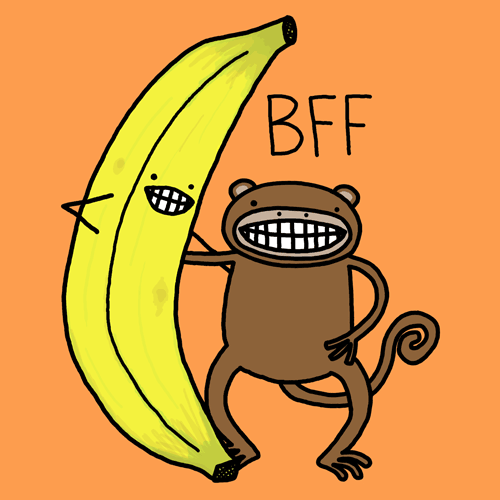
Kiowa's the monkey and Tim's the Banana. His spoon is too big.

Underwater Basket-Weaving is so Vanilla

"For a long while Jimmy Cross lay floating. In the clouds to the east there was the sound of a helicopter, but he did not take notice. With his eyes still closed, bobbing in the field, he let himself slip away. He was back home in New Jersey. A golden afternoon on the golf course, the fairways lush and green, and he was teeing it up on the first hole. It was a world without responsibility...." pg. 170

Granted, just about every chapter in this book is an anecdote, but I thought this chapter was particularly anecdote-y. It especially meets the requirements of showing the character of an individual, in this case two. I feel it redeems Norman Bowker from the sort of defamation O'Brien gives him, which is partly his fault and partly "made up to show the truth." However, this chapter was written to give the actual details of what happened in the grimy field (I'm really starting to run out of euphemisms here). Okay, so Norman is redeemed, but what I didn't expect was the inner workings of Jimmy Cross, the platoon's leader, to reveal how very much he is unlike a leader. I would probably act the same way as him, but how do you get higher up in the army and be so non-committal? 'Tis baffling, indeed.

Esh ish sho goot!

"I had been forced to omit the shit field and the rain and the death of Kiowa, replacing this material with events that better fit the book's narrative. As a consequence I'd lost the natural counterpoint between the lake and the field." pg. 153

=/ Well, one good thing about "Notes" is that it's mighty analytical. But once again, O'Brien kind of takes the wind out of my sails by acknowledging the same thing I just said. It's really difficult to blog about this book chapter by chapter. Some chapters are just a page or two, leaving me wondering what to do with them. Others are long and convoluted, with O'Brien's commentary. It's one thing to reflect on something, but to reflect on reflections is kind of...nyyeah. That's probably why Abby got confused on my previous posts about the made up dead guy. I'll explain, I promise! Just give me a few. I suppose a good thing about TSAR is that each chapter, being more structured than TTTC, made it a clear-cut on how to blog about it. It even had twenty chapters.

Illustrative, eh?